English
 Explore
 Content Creators Hub
EARN CREDIBILITY THROUGH HONESTY, CONSISTENCY, AND EXCELLENT SERVICE
Trust Is the Foundation of Every Successful Business
"People do business with those they trust. Before customers buy your solution, they buy confidence in you."
- David Onyibo Okaka
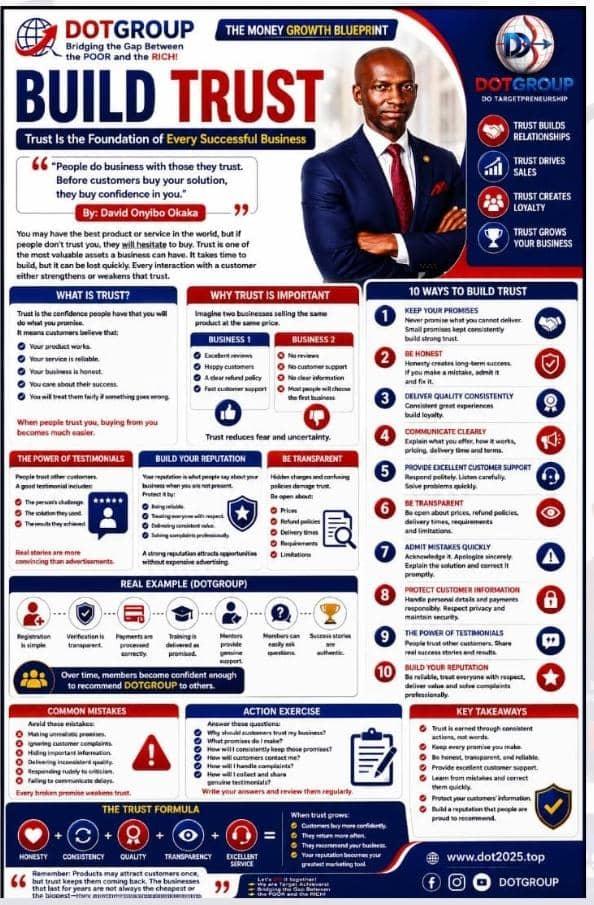
You may have the best product or service in the world, but if people don't trust you, they will hesitate to buy.
Trust is one of the most valuable assets a business can have. It takes time to build, but it can be lost quickly. Every interaction with a customer either strengthens or weakens that trust.
WHAT IS TRUST?
Trust is the confidence people have that you will do what you promise.
It means customers believe that:
Your product works.
Your service is reliable.
Your business is honest.
You care about their success.
You will treat them fairly if something goes wrong.
When people trust you, buying from you becomes much easier.
WHY TRUST IS IMPORTANT
Imagine two businesses selling the same product at the same price.
One business has:
Excellent reviews.
Happy customers.
A clear refund policy.
Fast customer support.
The other business has:
No reviews.
No customer support.
No clear information.
Most people will choose the first business because it feels safer.
Trust reduces fear and uncertainty.
HOW TO BUILD TRUST
1. Keep Your Promises
Never promise what you cannot deliver.
If you say:
Delivery takes three days, deliver in three days.
A course lasts six weeks, complete it in six weeks.
You provide support, be available.
Small promises kept consistently build strong trust.
2. Be Honest
Honesty creates long-term success.
If your product has limitations, explain them.
If you make a mistake, admit it and fix it.
Customers appreciate honesty more than perfection.
3. Deliver Quality Consistently
One great experience is good.
Consistent great experiences build loyalty.
Customers should receive the same high standard every time they interact with your business.
4. Communicate Clearly
People lose trust when they don't understand what is happening.
Always explain:
What you offer.
How it works.
Pricing.
Delivery time.
Terms and conditions.
Clear communication prevents misunderstandings.
5. Provide Excellent Customer Support
Customers should know they can reach you when they need help.
Respond politely.
Listen carefully.
Solve problems quickly.
Sometimes great customer service is remembered longer than the product itself.
THE POWER OF TESTIMONIALS
People trust other customers.
When someone shares their success story, it reassures new customers.
A good testimonial includes:
The person's challenge.
The solution they used.
The results they achieved.
Real stories are more convincing than advertisements.
BUILD YOUR REPUTATION
Your reputation is what people say about your business when you are not present.
Protect it by:
Being reliable.
Treating everyone with respect.
Delivering consistent value.
Solving complaints professionally.
A strong reputation attracts opportunities without expensive advertising.
BE TRANSPARENT
Hidden charges and confusing policies damage trust.
Be open about:
Prices.
Refund policies.
Delivery times.
Requirements.
Limitations.
Transparency shows respect for your customers.
Admit Mistakes Quickly
Every business makes mistakes.
The difference is how they respond.
If something goes wrong:
Acknowledge it.
Apologize sincerely.
Explain the solution.
Correct the problem promptly.
Many businesses gain more trust by handling mistakes well than by pretending they never happen.
PROTECT CUSTOMER INFORMATION
Customers trust you with their:
Personal details.
Contact information.
Payments.
Business information.
Handle this information responsibly.
Respect privacy and maintain security.
REAL EXAMPLE (DOTGROUP)
Suppose a member joins DOTGROUP.
Trust grows when:
Registration is simple.
Verification is transparent.
Payments are processed correctly.
Training is delivered as promised.
Mentors provide genuine support.
Members can easily ask questions.
Success stories are authentic.
Over time, members become confident enough to recommend DOTGROUP to others.
COMMON MISTAKES
Avoid these mistakes:
Making unrealistic promises.
Ignoring customer complaints.
Hiding important information.
Delivering inconsistent quality.
Responding rudely to criticism.
Failing to communicate delays.
Every broken promise weakens trust.
ACTION EXERCISE
Answer these questions:
Why should customers trust my business?
What promises do I make?
How will I consistently keep those promises?
How will customers contact me?
How will I handle complaints?
How will I collect and share genuine testimonials?
Write your answers and review them regularly.
THE TRUST FORMULA
A trustworthy business follows this pattern:
Honesty + Consistency + Quality + Transparency + Excellent Service = Customer Trust
When trust grows:
Customers buy more confidently.
They return more often.
They recommend your business.
Your reputation becomes your greatest marketing tool.
KEY TAKEAWAYS
Trust is earned through consistent actions, not words.
Keep every promise you make.
Be honest, transparent, and reliable.
Provide excellent customer support.
Learn from mistakes and correct them quickly.
Protect your customers' information.
Build a reputation that people are proud to recommend.
REMEMBER!
Products may attract customers once, but trust keeps them coming back. The businesses that last for years are not always the cheapest or the biggest—they are the ones people believe in.
QUESTIONS
OBJECTIVE
1. According to the lesson, trust is:
A. The confidence people have that you will do what you promise.
B. The amount of money a business makes.
C. The number of products a business sells.
D. The popularity of a business.
2. Why is trust important in business?
A. It reduces fear and uncertainty for customers.
B. It makes customers more willing to buy.
C. It encourages repeat business.
D. All of the above.
3. Which of the following is the best way to build trust?
A. Making promises you cannot keep.
B. Keeping your promises consistently.
C. Ignoring customer complaints.
D. Hiding important information.
4. According to the lesson, honesty means:
A. Never admitting mistakes.
B. Explaining limitations and correcting mistakes when they happen.
C. Charging customers more money.
D. Avoiding customer feedback.
5. Customers lose trust when:
A. Communication is clear.
B. Pricing and policies are transparent.
C. Information is confusing or incomplete.
D. Customer support is available.
6. What is the purpose of testimonials?
A. To criticize competitors.
B. To reassure new customers through real success stories.
C. To increase product prices.
D. To replace customer service.
7. A business reputation is:
A. The number of employees in a company.
B. What people say about your business when you are not present.
C. The size of your office.
D. The amount of advertising you do.
8. Which of the following should businesses protect to maintain customer trust?
A. Customer information and privacy.
B. Only business profits.
C. Competitors' information.
D. Social media accounts only.
9. Which of the following is listed as a common mistake?
A. Providing excellent customer support.
B. Being transparent about prices.
C. Making unrealistic promises.
D. Solving complaints professionally.
10. According to the Trust Formula, customer trust is built through:
A. Honesty + Consistency + Quality + Transparency + Excellent Service.
B. Advertising + Discounts + Popularity + Social Media.
C. Expensive Products + High Prices + Competition.
D. Marketing + Technology + Branding.
THEORY
1. Define trust and explain why it is the foundation of every successful business.
2. Discuss five practical ways entrepreneurs can build trust with their customers.
3. Explain the importance of honesty, transparency, and consistency in building long-term customer relationships.
4. Using the DOTGROUP example, explain how trust can be built through registration, verification, payments, training, mentorship, and customer support.
5. State and explain the Trust Formula: Honesty + Consistency + Quality + Transparency + Excellent Service = Customer Trust. Discuss how each element contributes to customer loyalty and business growth.
LEARN MORE WITH DOTGROUP
Build a trusted business and long-lasting customer relationships through:
- Customer trust strategies
- Business ethics & integrity
- Brand reputation management
- Customer service excellence
- Professional business growth
Visit: Our Courses
"Tust is the foundation of every successful business. Customers may come because of your marketing, but they stay because of your honesty, consistency, and the confidence that you will always deliver on your promises. Build trust, and success will follow."
By David Onyibo Okaka