English
 Explore
 Content Creators Hub
VALIDATE YOUR IDEA WITH REAL PEOPLE BEFORE EXPANDING
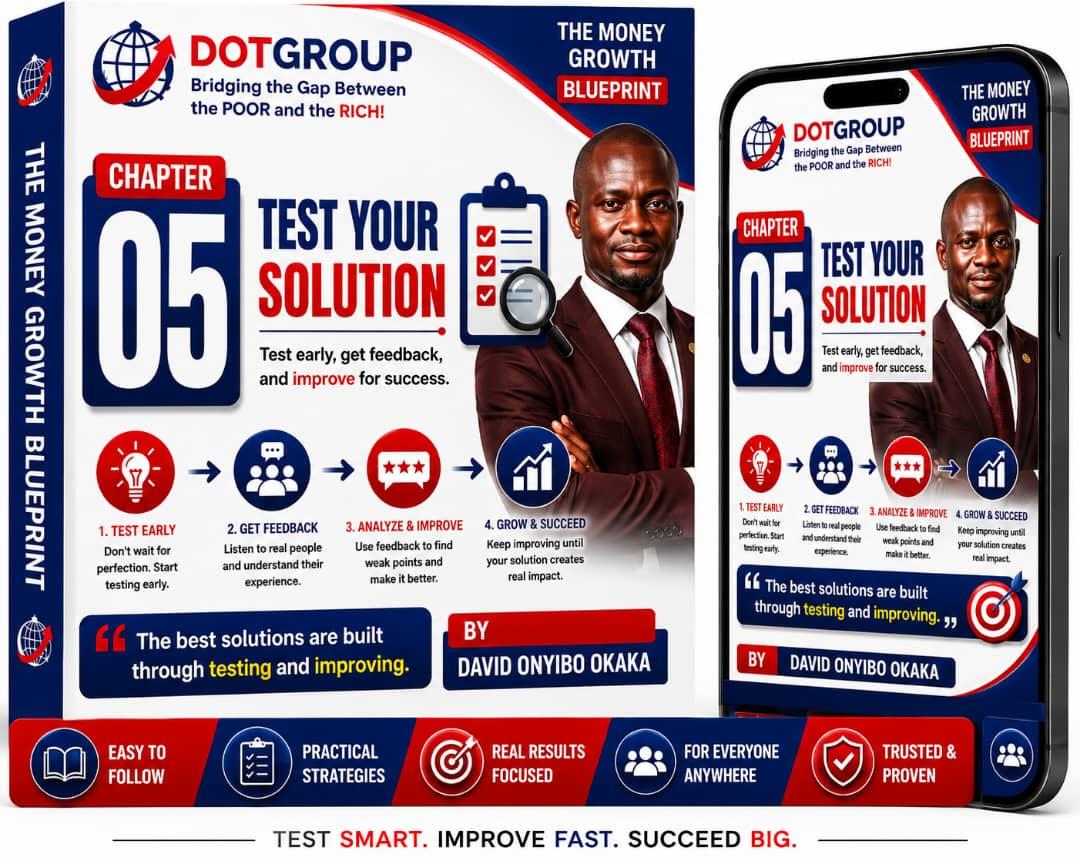 Prove It Works Before You Build Bigger
"Don't assume people will buy your solution. Test it first."
- David Onyibo Okaka
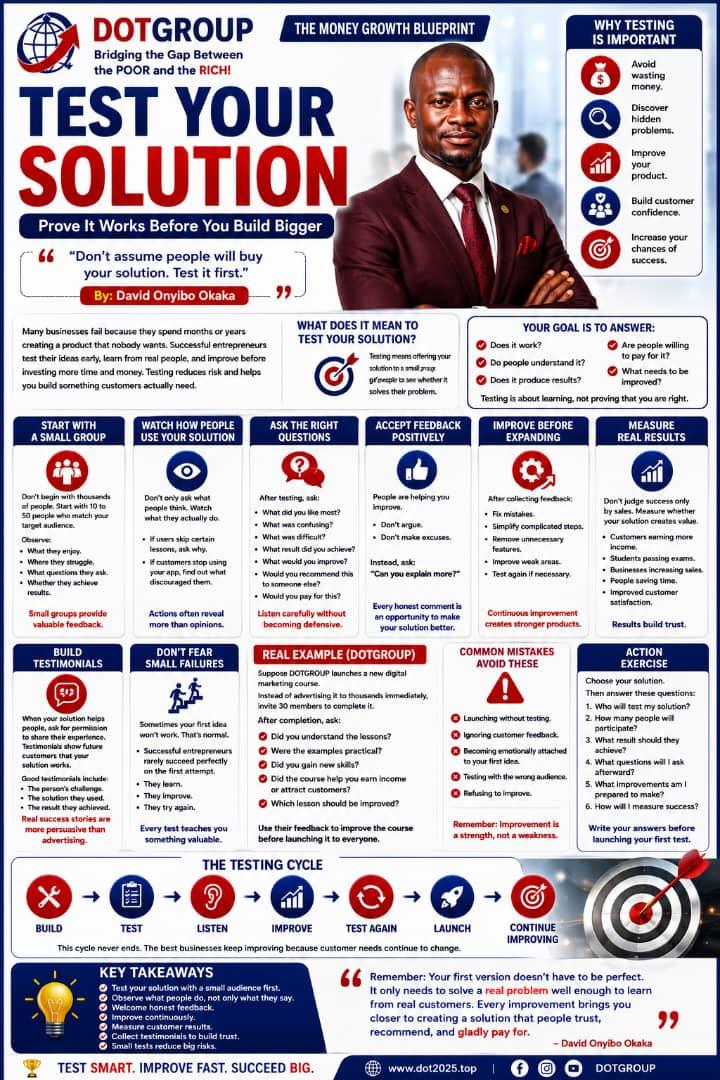
Many businesses fail because they spend months or years creating a product that nobody wants.
SUCCESSFUL TARGETPRENEURS DO SOMETHING DIFFERENT
They test their ideas early, learn from real people, and improve before investing more time and money.
Testing reduces risk and helps you build something customers actually need.
WHAT DOES IT MEAN TO TEST YOUR SOLUTION?
Testing means offering your solution to a small group of people to see whether it solves their problem.
Your goal is to answer questions like:
Does it work?
Do people understand it?
Does it produce results?
Are people willing to pay for it?
What needs to be improved?
Testing is about learning, not proving that you are right.
WHY TESTING IS IMPORTANT
Testing helps you:
Avoid wasting money.
Discover hidden problems.
Improve your product.
Build customer confidence.
Increase your chances of success.
A small test today can prevent a big failure tomorrow.
START WITH A SMALL GROUP
Don't begin with thousands of people.
Start with 10 to 50 people who match your target audience.
For example:
If you created a business course,
invite a small group of entrepreneurs to use it first.
Observe:
What they enjoy.
Where they struggle.
What questions they ask.
Whether they achieve results.
Small groups provide valuable feedback.
Watch HOW PEOPLE USE YOUR SOLUTION
Don't only ask what people think.
Watch what they actually do.
For example:
If users skip certain lessons,
ask why.
If customers stop using your app,
find out what discouraged them.
Actions often reveal more than opinions.
ASK THE RIGHT QUESTION
After testing, ask:
What did you like most?
What was confusing?
What was difficult?
What result did you achieve?
What would you improve?
Would you recommend this to someone else?
Would you pay for this?
Listen carefully without becoming defensive.
ACCEPT FEEDBACK POSITIVELY
Some feedback may be difficult to hear.
Remember:
People are helping you improve.
Don't argue.
Don't make excuses.
Instead, ask:
"Can you explain more?"
Every honest comment is an opportunity to make your solution better.
IMPROVE BEFORE EXPANDING
After collecting feedback:
Fix mistakes.
Simplify complicated steps.
Remove unnecessary features.
Improve weak areas.
Test again if necessary.
Continuous improvement creates stronger products.
MEASURE REAL RESULTS
Don't judge success only by sales.
Measure whether your solution creates value.
Examples include:
Customers earning more income.
Students passing exams.
Businesses increasing sales.
People saving time.
Improved customer satisfaction.
Results build trust.
BUILD TESTIMONIALS
When your solution helps people,
ask for permission to share their experience.
Testimonials show future customers that your solution works.
Good testimonials include:
The person's challenge.
The solution they used.
The result they achieved.
Real success stories are more persuasive than advertising.
DON'T FEAR SMALL FAILURE
Sometimes your first idea won't work.
That's normal.
Successful entrepreneurs rarely succeed perfectly on the first attempt.
They learn.
They improve.
They try again.
Every test teaches you something valuable.
REAL EXAMPLE (DOTGROUP)
Suppose DOTGROUP launches a new digital marketing course.
Instead of advertising it to thousands immediately,
invite 30 members to complete it.
After completion, ask:
Did you understand the lessons?
Were the examples practical?
Did you gain new skills?
Did the course help you earn income or attract customers?
Which lesson should be improved?
Use their feedback to improve the course before launching it to everyone.
COMMON MISTAKES
Avoid these mistakes:
Launching without testing.
Ignoring customer feedback.
Becoming emotionally attached to your first idea.
Testing with the wrong audience.
Refusing to improve.
REMEMBER!
Improvement is a strength, not a weakness.
ACTION EXERCISE
Choose your solution.
Then answer these questions:
Who will test my solution?
How many people will participate?
What result should they achieve?
What questions will I ask afterward?
What improvements am I prepared to make?
How will I measure success?
Write your answers before launching your first test.
THE TESTING CYCLE
A successful entrepreneur follows this simple cycle:
Build → Test → Listen → Improve → Test Again → Launch → Continue Improving
This cycle never ends.
The best businesses keep improving because customer needs continue to change.
KEY TAKEAWAYS
Test your solution with a small audience first.
Observe what people do, not only what they say.
Welcome honest feedback.
Improve continuously.
Measure customer results.
Collect testimonials to build trust.
Small tests reduce big risks.
REMEMBER!
Your first version doesn't have to be perfect. It only needs to solve a real problem well enough to learn from real customers. Every improvement brings you closer to creating a solution that people trust, recommend, and gladly pay for.
QUESTIONS
OBJECTIVE
1. What is the main purpose of testing your solution?
A. To make your product look attractive.
B. To learn whether your solution works and needs improvement.
C. To increase the price immediately.
D. To advertise to millions of people.
2. According to the lesson, testing your solution helps you:
A. Avoid wasting money.
B. Discover hidden problems.
C. Improve your product.
D. All of the above.
3. When testing a new solution, you should start with:
A. 1,000 to 5,000 people.
B. Everyone in your country.
C. 10 to 50 people from your target audience.
D. Your competitors.
4. While testing your solution, you should pay attention to:
A. What people actually do.
B. Only what people say.
C. The color of your logo.
D. Your competitors' advertisements.
5. Which of the following is a good question to ask after testing?
A. What did you like most?
B. What was confusing?
C. Would you recommend this to someone else?
D. All of the above.
6. How should entrepreneurs respond to customer feedback?
A. Ignore negative comments.
B. Argue with customers.
C. Accept feedback positively and use it to improve.
D. Remove customers from the programme.
7. According to the lesson, success should be measured mainly by:
A. The number of advertisements.
B. The real results customers achieve.
C. The number of employees.
D. The amount of office space.
8. What is the purpose of collecting testimonials?
A. To criticize competitors.
B. To show future customers that your solution works.
C. To increase your expenses.
D. To replace customer feedback.
9. Which of the following is NOT listed as a common mistake?
A. Launching without testing.
B. Ignoring customer feedback.
C. Improving your solution continuously.
D. Refusing to improve.
10. According to the Testing Cycle, what comes immediately after Listen?
A. Launch.
B. Improve.
C. Sell.
D. Advertise.
THEORY
1. Explain what it means to test your solution and discuss why testing is important before launching a product or service.
2. Describe the steps involved in testing a business solution with a small group of customers.
3. Discuss the importance of customer feedback and explain how entrepreneurs should respond to both positive and negative feedback.
4. Using the DOTGROUP digital marketing course example, explain how testing a solution before a full launch can improve customer satisfaction and business success.
5. Explain the Testing Cycle (Build → Test → Listen → Improve → Test Again → Launch → Continue Improving) and discuss why continuous improvement is essential for long-term business growth.
LEARN MORE WITH DOTGROUP
Identify your strengths and turn them into opportunities through:
- Skill assessment
- Professional courses
- Freelancing
- Content creation
- Career development
Visit: Our Courses
"Your greatest asset is not the money you have, but the value you are capable of creating. Discover your talent, develop it with excellence, and use it to solve problems that improve people's lives."
By David Onyibo Okaka