English
 Explore
 Content Creators Hub
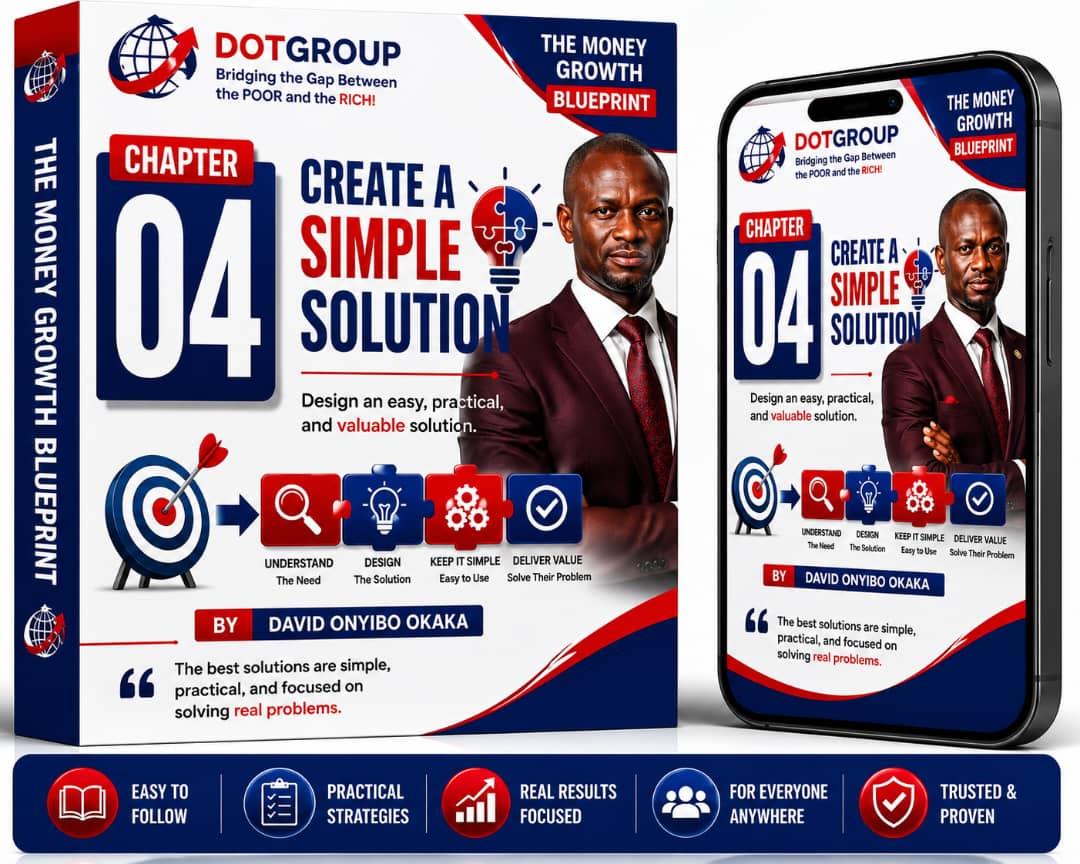
DESIGN AN EASY, PRACTICAL, AND VALUABLE SOLUTION
Turn Problems into Profitable Solutions
"The best businesses don't make life more complicated. They make life easier."
- David Onyibo Okaka
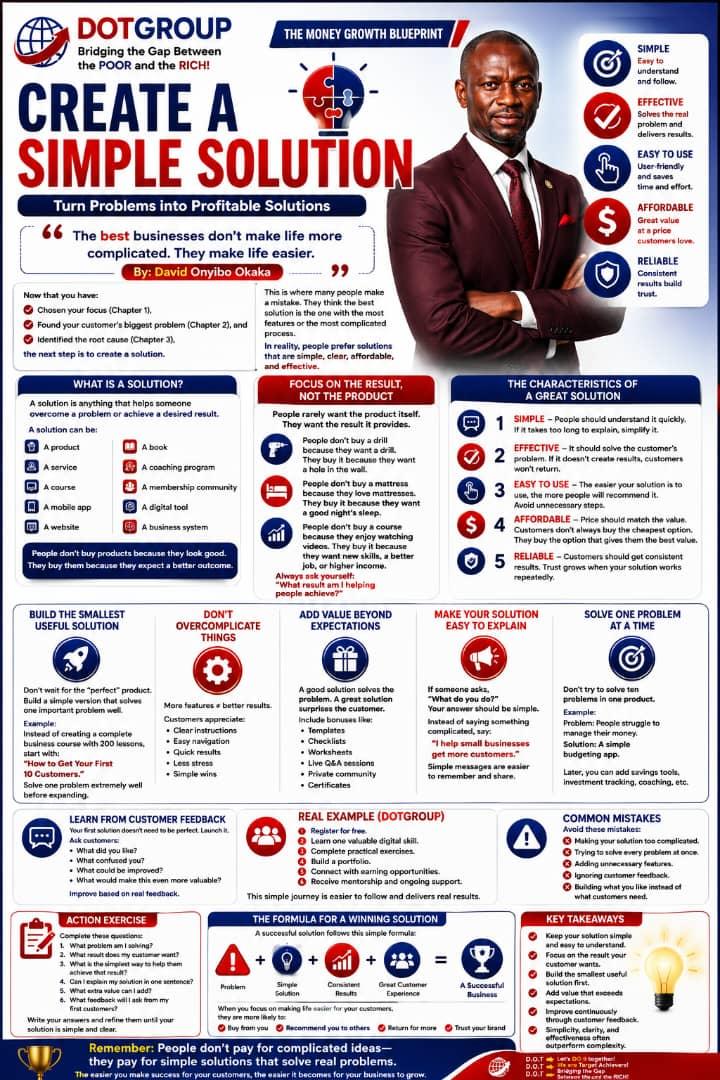
Now that you have:
Chosen your focus (Chapter 1),
Found your customer's biggest problem (Chapter 2), and
Identified the root cause (Chapter 3),
the next step is to create a solution.
This is where many people make a mistake. They think the best solution is the one with the most features or the most complicated process.
In reality, people prefer solutions that are simple, clear, affordable, and effective.
WHAT IS A SOLUTION?
A solution is anything that helps someone overcome a problem or achieve a desired result.
A solution can be:
A product
A service
A course
A mobile app
A website
A book
A coaching program
A membership community
A digital tool
A business system
People don't buy products because they look good. They buy them because they expect a better outcome.
FFOCUS ON THE RESULT, NOT THE PRODUCT
People rarely want the product itself.
They want the result it provides.
For example:
People don't buy a drill because they want a drill.
They buy it because they want a hole in the wall.
People don't buy a mattress because they love mattresses.
They buy it because they want a good night's sleep.
People don't buy a course because they enjoy watching videos.
They buy it because they want new skills, a better job, or higher income.
Always ask yourself:
"What result am I helping people achieve?"
The Characteristics of a Great Solution
A solution should be:
1. Simple
People should understand it quickly.
If it takes too long to explain, simplify it.
2. Effective
It should solve the customer's problem.
If it doesn't create results, customers won't return.
3. Easy to Use
The easier your solution is to use, the more people will recommend it.
Avoid unnecessary steps.
4. Affordable
Price should match the value.
Customers don't always buy the cheapest option.
They buy the option that gives them the best value.
5. Reliable
Customers should get consistent results.
Trust grows when your solution works repeatedly.
BUILD THE SMALLEST USEFUL SOLUTION
Many entrepreneurs spend years trying to create the "perfect" product.
Instead, build a simple version that solves one important problem well.
For example:
Instead of creating a complete business course with 200 lessons,
start with:
"How to Get Your First 10 Customers."
Solve one problem extremely well before expanding.
DON'T OVERCOMPLICATE THINGS
Many people believe adding more features makes a product better.
Often, it makes it more confusing.
Customers appreciate:
Clear instructions.
Easy navigation.
Quick results.
Less stress.
Simple wins.
ADD VALUE BEYOND EXPECTATIONS
A good solution solves the problem.
A great solution also surprises the customer.
For example:
If someone buys a business course,
you could include:
Free templates.
Checklists.
Worksheets.
Live Q&A sessions.
A private community.
Certificates.
These extras increase the perceived value without necessarily increasing costs significantly.
MAKE YOUR SOLUTION EASY TO EXPLAIN
If someone asks:
"What do you do?"
Your answer should be simple.
Instead of saying:
"I provide integrated entrepreneurial capacity development through innovative digital ecosystems."
Say:
"I help small businesses get more customers."
Simple messages are easier to remember and share.
SOLVE ONE PROBLEM AT A TIME
Don't try to solve ten problems in one product.
Instead:
Problem: People struggle to manage their money.
Solution: A simple budgeting app.
Later, you can add:
Savings tools.
Investment tracking.
Financial coaching.
Grow step by step.
LEARN FROM CUSTOMERS FEEDBACKS
Your first solution doesn't need to be perfect.
Launch it.
Ask customers:
What did you like?
What confused you?
What could be improved?
What would make this even more valuable?
Improve based on real feedback.
REAL EXAMPLE (DOTGROUP)
Suppose your audience is young people who want to earn online.
Instead of giving them dozens of unrelated lessons,
you could create a clear pathway:
Step 1: Register for free.
Step 2: Learn one valuable digital skill.
Step 3: Complete practical exercises.
Step 4: Build a portfolio.
Step 5: Connect with earning opportunities.
Step 6: Receive mentorship and ongoing support.
This simple journey is easier to follow than giving users everything at once.
COMMON MISTAKES
Avoid these mistakes:
Making your solution too complicated.
Trying to solve every problem at once.
Adding unnecessary features.
Ignoring customer feedback.
Building what you like instead of what customers need.
ACTION EXERCISE
Complete these questions:
What problem am I solving?
What result does my customer want?
What is the simplest way to help them achieve that result?
Can I explain my solution in one sentence?
What extra value can I add?
What feedback will I ask from my first customers?
Write your answers and refine them until your solution is simple and clear.
THE FORMULA FOR WINNING SOLUTION
A successful solution follows this simple formula:
Problem + Simple Solution + Consistent Results + Great Customer Experience = A Successful Business
When you focus on making life easier for your customers, they are more likely to:
Buy from you.
Recommend you to others.
Return for more.
Trust your brand.
KEY TAKEAWAYS
Keep your solution simple and easy to understand.
Focus on the result your customer wants.
Build the smallest useful solution first.
Add value that exceeds expectations.
Improve continuously through customer feedback.
Simplicity, clarity, and effectiveness often outperform complexity.
REMEMBER!
People don't pay for complicated ideas—they pay for simple solutions that solve real problems. The easier you make success for your customers, the easier it becomes for your business to grow.
QUESTIONS
OBJECTIVE
1. After choosing your focus, finding the customer's biggest problem, and identifying the root cause, what is the next step?
A. Increase your prices.
B. Create a simple solution.
C. Hire more employees.
D. Advertise everywhere.
2. A solution is best defined as:
A. Anything that looks attractive.
B. Anything that helps someone overcome a problem or achieve a desired result.
C. A product that is expensive.
D. A business with many employees.
3. According to the lesson, people buy products mainly because they:
A. Like the appearance of the product.
B. Want the results the product provides.
C. Want to impress others.
D. Enjoy spending money.
4. Which of the following is NOT listed as a characteristic of a great solution?
A. Simple.
B. Reliable.
C. Complicated.
D. Effective.
5. Instead of creating a course with 200 lessons, the lesson recommends:
A. Waiting until it is perfect.
B. Building the smallest useful solution first.
C. Adding more features immediately.
D. Offering many unrelated topics.
6. Which of the following adds value beyond customer expectations?
A. Making the product more confusing.
B. Providing free templates, checklists, or certificates.
C. Increasing the price without improving the product.
D. Removing customer support.
7. A good business message should be:
A. Long and technical.
B. Difficult to understand.
C. Simple and easy to remember.
D. Filled with complex business terms.
8. What should entrepreneurs do after launching their first solution?
A. Ignore customer opinions.
B. Stop improving the product.
C. Gather customer feedback and make improvements.
D. Create another unrelated product immediately.
9. Which of the following is a common mistake?
A. Solving one problem at a time.
B. Making the solution too complicated.
C. Listening to customer feedback.
D. Building a simple solution.
10. According to the formula for a winning solution, a successful business is built through:
A. Expensive products + Advertising + Many employees.
B. Problem + Simple Solution + Consistent Results + Great Customer Experience.
C. Marketing + High Prices + Competition.
D. Technology + Money + Popularity.
THEORY
1. Explain what a solution is and discuss why customers buy results rather than products.
2. Describe the five characteristics of a great solution and explain why each is important.
3. Discuss why entrepreneurs should build the smallest useful solution first instead of waiting to create a perfect product.
4. Using the DOTGROUP example, explain how a simple step-by-step solution can be more effective than giving customers too much information at once.
5. State and explain the Formula for a Winning Solution. Discuss how each part of the formula contributes to building a successful business.
LEARN MORE WITH DOTGROUP
Develop the mindset of successful entrepreneurs through:
- Personal development courses
- Leadership training
- Success habits
- Goal-setting programmes
- Productivity systems
Visit: Our Courses
"Every lasting transformation begins in the mind. When you change the way you think—from earning money to creating value—you begin the journey from ordinary success to extraordinary impact."
- David Onyibo Okaka