English
 Explore
 Content Creators Hub
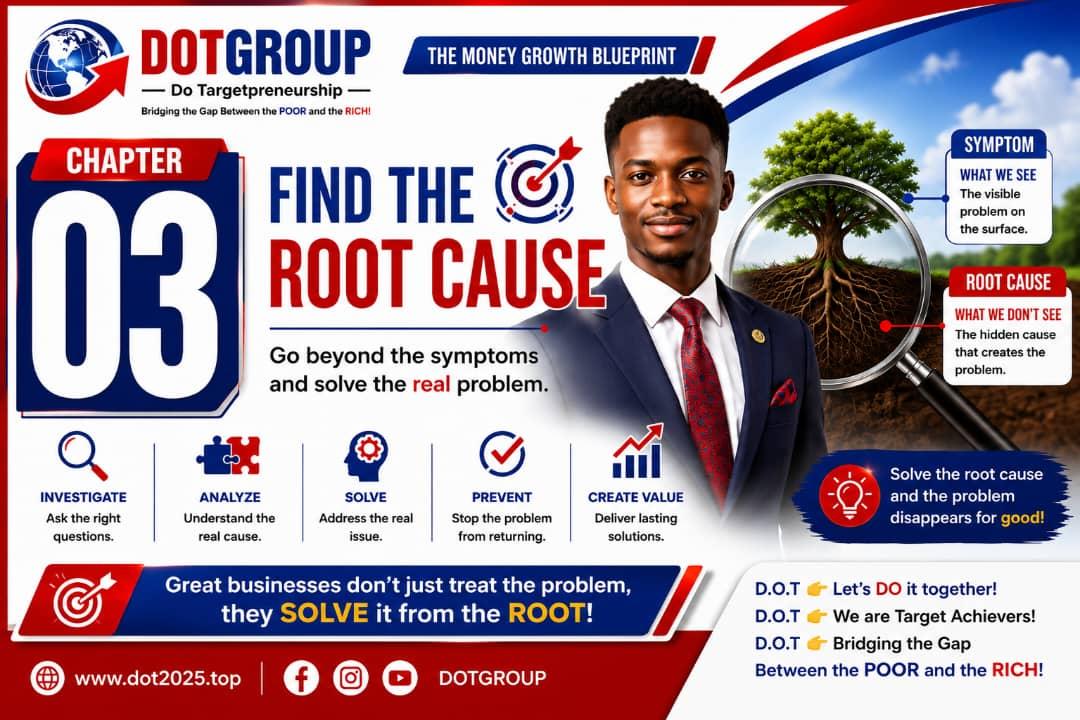
GO BEYOND THE SYMPTOMS AND SOLVE THE REAL PROBLEM
Solve the Cause, Not Just the Symptoms
"If you only treat the symptom, the problem will keep coming back. If you solve the root cause, you create lasting value."
By: David Onyibo Okaka
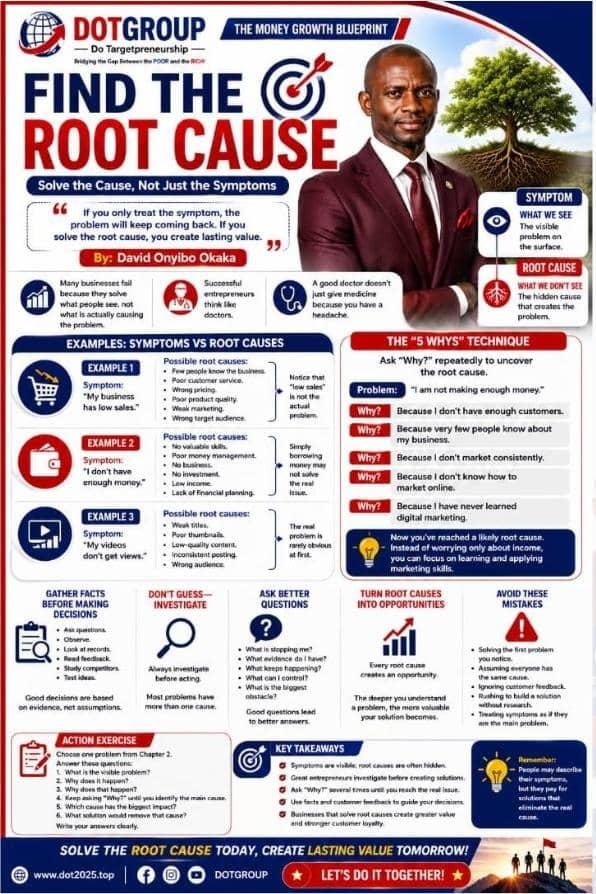
Many businesses fail because they solve what people see, not what is actually causing the problem.
SUCCESSFUL TARGETPRENEURS THINK LIKE DOCTORS
A good doctor doesn't just give medicine because you have a headache.
They first ask:
Why do you have the headache?
Is it stress?
Is it dehydration?
Is it poor eyesight?
Is it an infection?
The treatment depends on the real cause.
Business works the same way.
WHAT IS the ROOT CAUSE?
The root cause is the main reason a problem exists.
It is the hidden issue behind the visible problem.
Think of a tree.
The leaves represent the visible problem.
The branches represent the effects.
The roots represent the real cause.
If you cut off the leaves, they grow back.
If you remove the roots, the problem disappears.
SYMPTOMS VS ROOT CAUSES
Many people only notice symptoms.
Example 1
Symptom: "My business has low sales."
Possible root causes:
Few people know the business.
Poor customer service.
Wrong pricing.
Poor product quality.
Weak marketing.
Wrong target audience.
Notice that "low sales" is not the actual problem.
Example 2
Symptom: "I don't have enough money."
Possible root causes:
No valuable skills.
Poor money management.
No business.
No investment.
Low income.
Lack of financial planning.
Simply borrowing money may not solve the real issue.
Example 3
Symptom: "My videos don't get views."
Possible root causes:
Weak titles.
Poor thumbnails.
Low-quality content.
Inconsistent posting.
Wrong audience.
The real problem is rarely obvious at first.
Why Finding the Root Cause Is Important
When you solve the real problem:
Customers get better results.
They trust you more.
They recommend you to others.
Your solution becomes more valuable.
You build a stronger reputation.
Businesses that solve root causes often keep customers for much longer.
THE "5 WHYS" TECHNIQUES
One of the simplest ways to uncover the root cause is to ask "Why?" repeatedly.
Example
Problem: "I am not making enough money."
Why? Because I don't have enough customers.
Why? Because very few people know about my business.
Why? Because I don't market consistently.
Why? Because I don't know how to market online.
Why? Because I have never learned digital marketing.
Now you've reached a likely root cause.
Instead of worrying only about income, you can focus on learning and applying marketing skills.
GATHER FACTS BEFORE MAKING DECISIONS
Never assume you already know the cause.
Collect information by:
Asking questions.
Observing.
Looking at sales records.
Reading customer feedback.
Studying competitors.
Testing different ideas.
Good decisions are based on evidence, not assumptions.
Don't Guess—Investigate
Imagine a restaurant losing customers.
The owner thinks:
"The food must be the problem."
After speaking with customers, they discover:
Customers love the food.
Prices are reasonable.
The real complaint is slow service.
If the owner changes the menu instead of improving service, nothing changes.
Always investigate before acting.
MOST PROBLEMS HAVE MORE THAN ONE CAUSE
Some problems are connected.
For example:
Low business profits may result from:
Poor marketing.
High operating costs.
Weak customer service.
Poor financial management.
Low product quality.
Instead of fixing only one area, prioritize the causes that have the biggest impact.
ASK BETTER QUESTIONS
Instead of asking:
"Why am I failing?"
Ask:
What is stopping me from succeeding?
What evidence do I have?
What keeps happening repeatedly?
What can I control?
What is the biggest obstacle?
Good questions lead to better answers.
TURN ROOT CAUSES INTO BUSINESS OPPORTUNITIES
Every root cause creates an opportunity.
For example:
Problem: Students fail exams.
Root causes:
Poor study methods.
Lack of guidance.
Weak understanding of key subjects.
Business opportunity: Create a learning system with structured lessons, practice tests, and mentorship.
Problem: Small businesses struggle.
Root causes:
Poor marketing.
Weak bookkeeping.
No business plan.
Business opportunity: Offer business coaching, accounting support, and marketing services.
REAL EXAMPLE (DOTGROUP)
Suppose many young people say:
"I can't find a job."
The obvious solution is to help them apply for jobs.
But the root causes may be:
Lack of practical skills.
No professional CV.
Poor interview preparation.
Limited networking.
No digital portfolio.
A stronger solution is a complete career development program that includes:
Skill training.
CV writing.
Interview coaching.
Networking opportunities.
Job matching.
This solves the real causes rather than just the visible problem.
AVOID THESE MISTAKES
Solving the first problem you notice.
Assuming everyone has the same cause.
Ignoring customer feedback.
Rushing to build a solution without research.
Treating symptoms as if they are the main problem.
ACTION EXERCISE
Choose one problem from Chapter 2.
Answer these questions:
What is the visible problem?
Why does it happen?
Why does that happen?
Keep asking "Why?" until you identify the main cause.
Which cause has the biggest impact?
What solution would remove that cause?
Write your answers clearly.
KEY TAKEAWAYS
Symptoms are visible; root causes are often hidden.
Great entrepreneurs investigate before creating solutions.
Ask "Why?" several times until you reach the real issue.
Use facts and customer feedback to guide your decisions.
Businesses that solve root causes create greater value and stronger customer loyalty.
REMEMBER!
People may describe their symptoms, but they pay for solutions that eliminate the real cause. The deeper you understand a problem, the more valuable your solution becomes—and the more people will be willing to pay for it.
QUESTIONS
OBJECTIVE
1. According to the lesson, successful entrepreneurs think like:
A. Teachers
B. Doctors
C. Lawyers
D. Engineers
2. What is the root cause?
A. The visible problem people complain about.
B. The effect of a problem.
C. The main reason a problem exists.
D. A temporary solution.
3. In the tree illustration, what do the roots represent?
A. The visible problem.
B. The effects of the problem.
C. The real cause of the problem.
D. The customers.
4. Which of the following is a symptom rather than a root cause?
A. Poor marketing.
B. Weak customer service.
C. Low sales.
D. Wrong target audience.
5. What is the purpose of the "5 Whys" technique?
A. To increase sales quickly.
B. To uncover the real cause of a problem.
C. To advertise a business.
D. To reduce business expenses.
6. Before making decisions, entrepreneurs should:
A. Depend on assumptions.
B. Copy competitors immediately.
C. Gather facts and evidence.
D. Ignore customer feedback.
7. In the restaurant example, what was the real cause of losing customers?
A. Poor food quality.
B. High prices.
C. Slow customer service.
D. Lack of tables.
8. According to the lesson, most business problems:
A. Have only one cause.
B. Have more than one contributing cause.
C. Cannot be solved.
D. Are caused by customers.
9. Which of the following is NOT listed as a common mistake?
A. Ignoring customer feedback.
B. Solving the first problem you notice.
C. Investigating before acting.
D. Treating symptoms as the main problem.
10. According to the key takeaway, people pay for:
A. Attractive advertisements.
B. Expensive products.
C. Solutions that eliminate the real cause of their problems.
D. Businesses with many employees.
THEORY
1. Explain the difference between a symptom and a root cause, using two examples from the lesson.
2. Describe the "5 Whys" technique and explain how it helps entrepreneurs identify the root cause of a problem.
3. Discuss five reasons why finding the root cause is important before creating a business solution.
4. Explain how entrepreneurs can gather facts before making decisions and why evidence is better than assumptions.
5. Using the DOTGROUP job seeker example, explain how identifying the root causes of unemployment leads to a more valuable and effective business solution.
LEARN MORE WITH DOTGROUP
Ready to build systems that create lasting wealth?
Discover:
- Technology-driven entrepreneurship
- Digital business creation
- AI and automation
- Scalable business systems
- Innovation training
- Global networking
Visit: Our Courses
"Create systems that continue creating value long after you are gone."
By David Onyibo Okaka