English
 Explore
 Content Creators Hub
IDENTIFY THE RIGHT PEOPLE TO SERVE AND THE PROBLEM YOU WANT TO SOLVE

The First Step to Making More Money
"If you try to help everyone, you will end up helping no one."
- David Onyibo Okaka
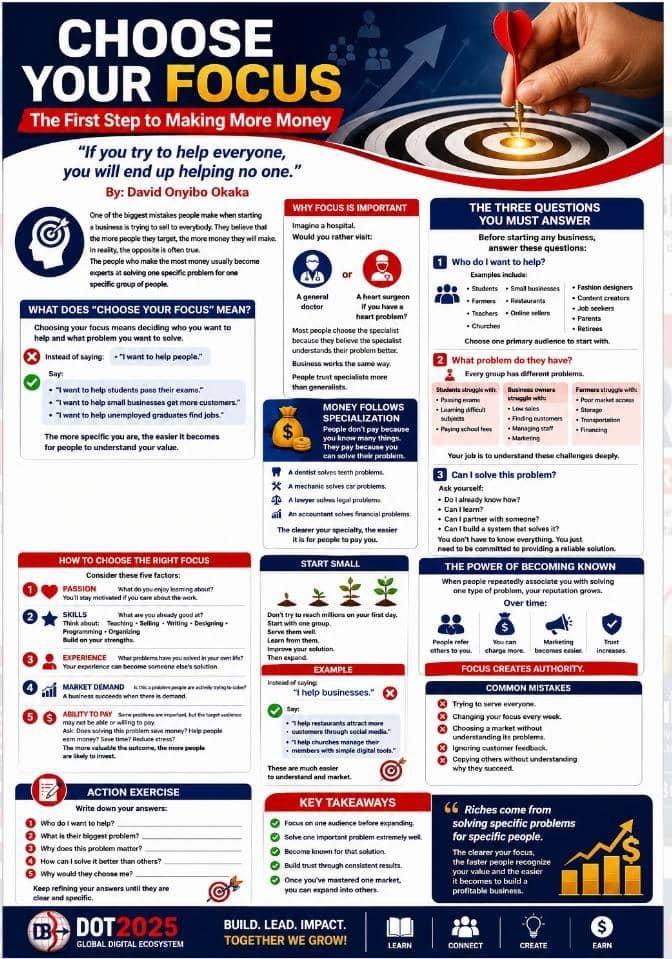
One of the biggest mistakes people make when starting a business is trying to sell to everybody. They believe that the more people they target, the more money they will make. In reality, the opposite is often true.
The people who make the most money usually become experts at solving one specific problem for one specific group of people.
WHAT DOES "CHOOSE YOUR FOCUS" MEAN?
Choosing your focus means deciding who you want to help and what problem you want to solve.
Instead of saying:
"I want to help people."
Say:
"I want to help students pass their exams."
Or
"I want to help small businesses get more customers."
Or
"I want to help unemployed graduates find jobs."
The more specific you are, the easier it becomes for people to understand your value.
WHY FOCUS IS IMPORTANT
Imagine a hospital.
Would you rather visit:
A general doctor
or
A heart surgeon if you have a heart problem?
Most people choose the specialist because they believe the specialist understands their problem better.
Business works the same way.
People trust specialists more than generalists.
Money Follows Specialization
People don't pay because you know many things.
They pay because you can solve their problem.
For example:
A dentist solves teeth problems.
A mechanic solves car problems.
A lawyer solves legal problems.
An accountant solves financial problems.
The clearer your specialty, the easier it is for people to pay you.
THE THREE QUESTIONS YOU MUST ANSWER
Before starting any business, answer these questions:
1. Who do I want to help?
Examples include:
Students
Farmers
Teachers
Churches
Small businesses
Restaurants
Online sellers
Fashion designers
Content creators
Job seekers
Parents
Retirees
Choose one primary audience to start with.
2. What problem do they have?
Every group has different problems.
For example:
Students struggle with:
Passing exams
Learning difficult subjects
Paying school fees
Business owners struggle with:
Low sales
Finding customers
Managing staff
Marketing
Farmers struggle with:
Poor market access
Storage
Transportation
Financing
Your job is to understand these challenges deeply.
3. Can I solve this problem?
Ask yourself:
Do I already know how?
Can I learn?
Can I partner with someone?
Can I build a system that solves it?
You don't have to know everything. You just need to be committed to providing a reliable solution.
HOW TO CHOOSE THE RIGHT FOCUS
Consider these five factors:
1. Passion
What do you enjoy learning about?
You'll stay motivated if you care about the work.
2. Skills
What are you already good at?
Think about:
Teaching
Selling
Writing
Designing
Programming
Organizing
Build on your strengths.
3. Experience
What problems have you solved in your own life?
Your experience can become someone else's solution.
4. Market Demand
Is this a problem people are actively trying to solve?
A business succeeds when there is demand.
5. Ability to Pay
Some problems are important, but the target audience may not be able or willing to pay.
Ask:
Does solving this problem save money?
Help people earn money?
Save time?
Reduce stress?
The more valuable the outcome, the more people are likely to invest.
SSTART SMALL
Don't try to reach millions on your first day.
Start with one group.
Serve them well.
Learn from them.
Improve your solution.
Then expand.
Example
Instead of saying:
"I help businesses."
Say:
"I help restaurants attract more customers through social media."
Or:
"I help churches manage their members with simple digital tools."
These are much easier to understand and market.
THE POWER OF BECOMING KNOWN
When people repeatedly associate you with solving one type of problem, your reputation grows.
Over time:
People refer others to you.
You can charge more.
Marketing becomes easier.
Trust increases.
Focus creates authority.
COMMON MISTAKES
Trying to serve everyone.
Changing your focus every week.
Choosing a market without understanding its problems.
Ignoring customer feedback.
Copying others without understanding why they succeed.
ACTION EXERCISE
Write down your answers:
Who do I want to help?
What is their biggest problem?
Why does this problem matter?
How can I solve it better than others?
Why would they choose me?
Keep refining your answers until they are clear and specific.
KEY TAKEAWAYS
Focus on one audience before expanding.
Solve one important problem extremely well.
Become known for that solution.
Build trust through consistent results.
Once you've mastered one market, you can expand into others.
REMEMBER!
Riches come from solving specific problems for specific people. The clearer your focus, the faster people recognize your value and the easier it becomes to build a profitable business.
QUESTIONS
OBJECTIVE
1. What does "Choose Your Focus" primarily mean?
A. Selling to everyone
B. Choosing who you want to help and what problem you want to solve
C. Starting many businesses at once
D. Advertising everywhere
2. Why do people generally trust specialists more than generalists?
A. Specialists charge lower prices.
B. Specialists advertise more.
C. Specialists are believed to understand specific problems better.
D. Specialists work fewer hours.
3. Before starting a business, what are the three important questions you should answer?
A. Where will I travel? Who will employ me? How much money do I have?
B. Who do I want to help? What problem do they have? Can I solve it?
C. Who is my competitor? What is my age? Where do I live?
D. How many employees do I need? Where is my office? What is my salary?
4. Which of the following is NOT one of the five factors to consider when choosing your focus?
A. Passion
B. Skills
C. Market Demand
D. Popularity on social media
5. According to the lesson, what is one common mistake entrepreneurs make?
A. Starting with one target audience
B. Solving one important problem well
C. Trying to serve everyone
D. Building trust through consistent results
6. Which of the following is an example of a well-defined business focus?
A. I want to help everyone.
B. I want to sell anything to anybody.
C. I help restaurants attract more customers through social media.
D. I want to become famous.
7. According to the lesson, what should you do after successfully serving one target audience?
A. Stop the business.
B. Change your focus every week.
C. Expand into other markets gradually.
D. Increase your prices immediately.
8. Which of the following is NOT listed as a common mistake?
A. Trying to serve everyone.
B. Ignoring customer feedback.
C. Understanding your customers' problems.
D. Changing your focus every week.
9. Why is it important to consider the target audience's ability to pay?
A. Because every customer is rich.
B. Because solving valuable problems increases the likelihood that people will pay for your solution.
C. Because only large businesses buy products.
D. Because marketing becomes unnecessary.
10. According to the key takeaway, riches come from:
A. Selling many different products to everyone.
B. Working long hours every day.
C. Solving specific problems for specific people.
D. Copying successful businesses.
THEORY
1. Explain what "Choose Your Focus" means and discuss why it is important for business success.
2. List and explain the three questions every entrepreneur should answer before starting a business.
3. Discuss the five factors to consider when choosing the right business focus.
4. Explain the importance of specialization in business and how it helps increase trust, reputation, and income.
5. Identify and explain five common mistakes entrepreneurs make when choosing their business focus and suggest how these mistakes can be avoided.
LEARN MORE WITH DOTGROUP
Ready to break free from the Poor World?
Visit the DOTGROUP platform to access:
- Free digital education
- Professional skill development
- Entrepreneurship training
- Employment opportunities
- Business communities
- Mentorship programmes
Visit: Our Courses
"Your journey out of poverty begins with knowledge, skills, and the right community."
BY David Onyibo Okaka