English
 Explore
 Content Creators Hub
KEEP LEARNING, INNOVATING, AND ADAPTING TO ACHIEVE LASTING SUCCESS
The Secret to Long-Term Success
"The moment you stop learning and improving, your business begins to fall behind."
- David Onyibo Okaka
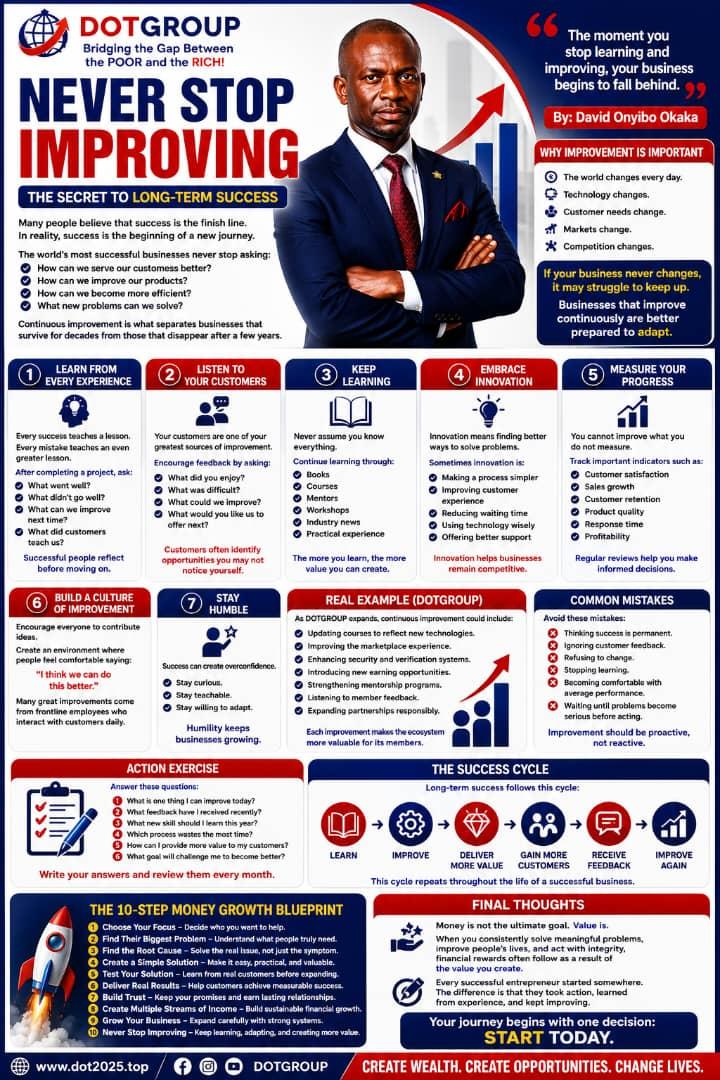
Many people believe that success is the finish line.
In reality, success is the beginning of a new journey.
The world's most successful businesses never stop asking:
How can we serve our customers better?
How can we improve our products?
How can we become more efficient?
What new problems can we solve?
Continuous improvement is what separates businesses that survive for decades from those that disappear after a few years.
WHAT DOES CONTINUOUS IMPROVEMENT MEAN?
Continuous improvement means making your business, your products, your services, and yourself better every day.
Improvement doesn't always require big changes.
Small improvements made consistently create remarkable results over time.
For example:
Responding to customers faster.
Improving product quality.
Learning a new skill.
Simplifying a process.
Reducing costs.
Improving customer service.
Small improvements add up.
Why Improvement Is Important
The world changes every day.
Technology changes.
Customer needs change.
Markets change.
Competition changes.
If your business never changes, it may struggle to keep up.
Businesses that improve continuously are better prepared to adapt.
LEARN FROM EVERY EXPERIENCE
Every success teaches a lesson.
Every mistake teaches an even greater lesson.
After completing a project, ask:
What went well?
What didn't go well?
What can we improve next time?
What did customers teach us?
Successful people reflect before moving on.
Listen to Your Customers
Your customers are one of your greatest sources of improvement.
Encourage feedback by asking:
What did you enjoy?
What was difficult?
What could we improve?
What would you like us to offer next?
Customers often identify opportunities you may not notice yourself.
KEEP LEARNING
Never assume you know everything.
Continue learning through:
Books.
Courses.
Mentors.
Workshops.
Industry news.
Practical experience.
The more you learn, the more value you can create.
Embrace Innovation
Innovation means finding better ways to solve problems.
It doesn't always require inventing something completely new.
Sometimes innovation is:
Making a process simpler.
Improving customer experience.
Reducing waiting time.
Using technology wisely.
Offering better support.
Innovation helps businesses remain competitive.
MEASURE YOUR PROGRESS
You cannot improve what you do not measure.
Track important indicators such as:
Customer satisfaction.
Sales growth.
Customer retention.
Product quality.
Response time.
Profitability.
Regular reviews help you make informed decisions.
Build a Culture of Improvement
If you have a team, encourage everyone to contribute ideas.
Create an environment where people feel comfortable saying:
"I think we can do this better."
Many great improvements come from frontline employees who interact with customers every day.
STAY HUMBLE
Success can sometimes create overconfidence.
Never believe your business has nothing left to learn.
Stay curious.
Stay teachable.
Stay willing to adapt.
Humility keeps businesses growing.
REAL EXAMPLE (DOTGROUP)
As DOTGROUP expands, continuous improvement could include:
Updating courses to reflect new technologies.
Improving the marketplace experience.
Enhancing security and verification systems.
Introducing new earning opportunities.
Strengthening mentorship programs.
Listening to member feedback.
Expanding partnerships responsibly.
Each improvement makes the ecosystem more valuable for its members.
COMMON MISTAKES
Avoid these mistakes:
Thinking success is permanent.
Ignoring customer feedback.
Refusing to change.
Stopping learning.
Becoming comfortable with average performance.
Waiting until problems become serious before acting.
Improvement should be proactive, not reactive.
ACTION EXERCISE
Answer these questions:
What is one thing I can improve today?
What feedback have I received recently?
What new skill should I learn this year?
Which process wastes the most time?
How can I provide more value to my customers?
What goal will challenge me to become better?
Write your answers and review them every month.
THE SUCCESS CYCLE
Long-term success follows this cycle:
Learn → Improve → Deliver More Value → Gain More Customers → Receive Feedback → Improve Again
This cycle repeats throughout the life of a successful business.
THE 10-STEP MONEY GROWTH BLUEPRINT
CONGRATULATIONS!!!
You have completed THE MONEY GROWTH BLUEPRINT. Let's recap the journey:
Choose Your Focus – Decide who you want to help.
Find Their Biggest Problem – Understand what people truly need.
Find the Root Cause – Solve the real issue, not just the symptom.
Create a Simple Solution – Make it easy, practical, and valuable.
Test Your Solution – Learn from real customers before expanding.
Deliver Real Results – Help customers achieve measurable success.
Build Trust – Keep your promises and earn lasting relationships.
Create Multiple Streams of Income – Build sustainable financial growth.
Grow Your Business – Expand carefully with strong systems.
Never Stop Improving – Keep learning, adapting, and creating more value.
FINAL THOUGHTS
Money is not the ultimate goal.
Value is.
When you consistently solve meaningful problems, improve people's lives, and act with integrity, financial rewards often follow as a result of the value you create.
Every successful entrepreneur started somewhere. The difference is that they took action, learned from experience, and kept improving.
Your journey begins with one decision:
Start today.
QUESTIONS
OBJECTIVE
1. According to the lesson, continuous improvement means:
A. Making your business, products, services, and yourself better every day.
B. Starting a new business every year.
C. Selling more expensive products.
D. Hiring more employees.
2. Why is continuous improvement important?
A. Because technology, markets, and customer needs continue to change.
B. Because customers never change.
C. Because businesses should never plan ahead.
D. Because competition does not exist.
3. After completing a project, what should successful entrepreneurs do?
A. Move on without reviewing the project.
B. Reflect on what went well, what didn't, and what can be improved.
C. Ignore customer feedback.
D. Start a different business.
4. Which of the following is NOT listed as a way to keep learning?
A. Reading books.
B. Taking courses.
C. Learning from mentors.
D. Ignoring industry news.
5. Innovation means:
A. Finding better ways to solve problems.
B. Copying competitors without thinking.
C. Increasing prices every month.
D. Hiring more workers.
6. According to the lesson, what should businesses measure?
A. Customer satisfaction.
B. Sales growth.
C. Profitability.
D. All of the above.
7. A culture of improvement encourages team members to:
A. Keep quiet about problems.
B. Suggest better ways of doing things.
C. Ignore customers.
D. Avoid responsibility.
8. Why is humility important in business?
A. It keeps business owners willing to learn and adapt.
B. It helps businesses avoid customers.
C. It guarantees instant success.
D. It reduces competition.
9. Which of the following is listed as a common mistake?
A. Listening to customer feedback.
B. Thinking success is permanent.
C. Updating products regularly.
D. Learning new skills.
10. According to the Success Cycle, what comes immediately after Gain More Customers?
A. Improve Again.
B. Learn.
C. Receive Feedback.
D. Deliver More Value.
THEORY
1. Explain the meaning of continuous improvement and discuss why it is essential for long-term business success.
2. Describe five practical ways entrepreneurs can continuously improve themselves and their businesses.
3. Discuss the importance of customer feedback, innovation, and measuring progress in helping a business remain competitive.
4. Using the DOTGROUP example, explain how continuous improvement can strengthen the DOTGROUP ecosystem and create greater value for members.
5. State and explain the Success Cycle:
Learn → Improve → Deliver More Value → Gain More Customers → Receive Feedback → Improve Again
Discuss how each stage contributes to sustainable business growth and long-term success.
LEARN MORE WITH DOTGROUP
Build a culture of continuous growth and long-term success through:
- Personal and professional development
- Business improvement strategies
- Leadership and innovation training
- Digital transformation
- Performance management
- Continuous learning and mentorship
Visit: Our Courses
"The day you stop improving is the day you stop growing. Success is not a destination but a continuous journey of learning, adapting, and creating greater value. Those who improve every day become the leaders of tomorrow."
- David Onyibo Okaka