English
 Explore
 Content Creators Hub
IDENTIFY THE CHARACTERISTICS OF POVERTY, SURVIVAL LIVING, AND THE LIMITATIONS THAT PREVENT GROWTH
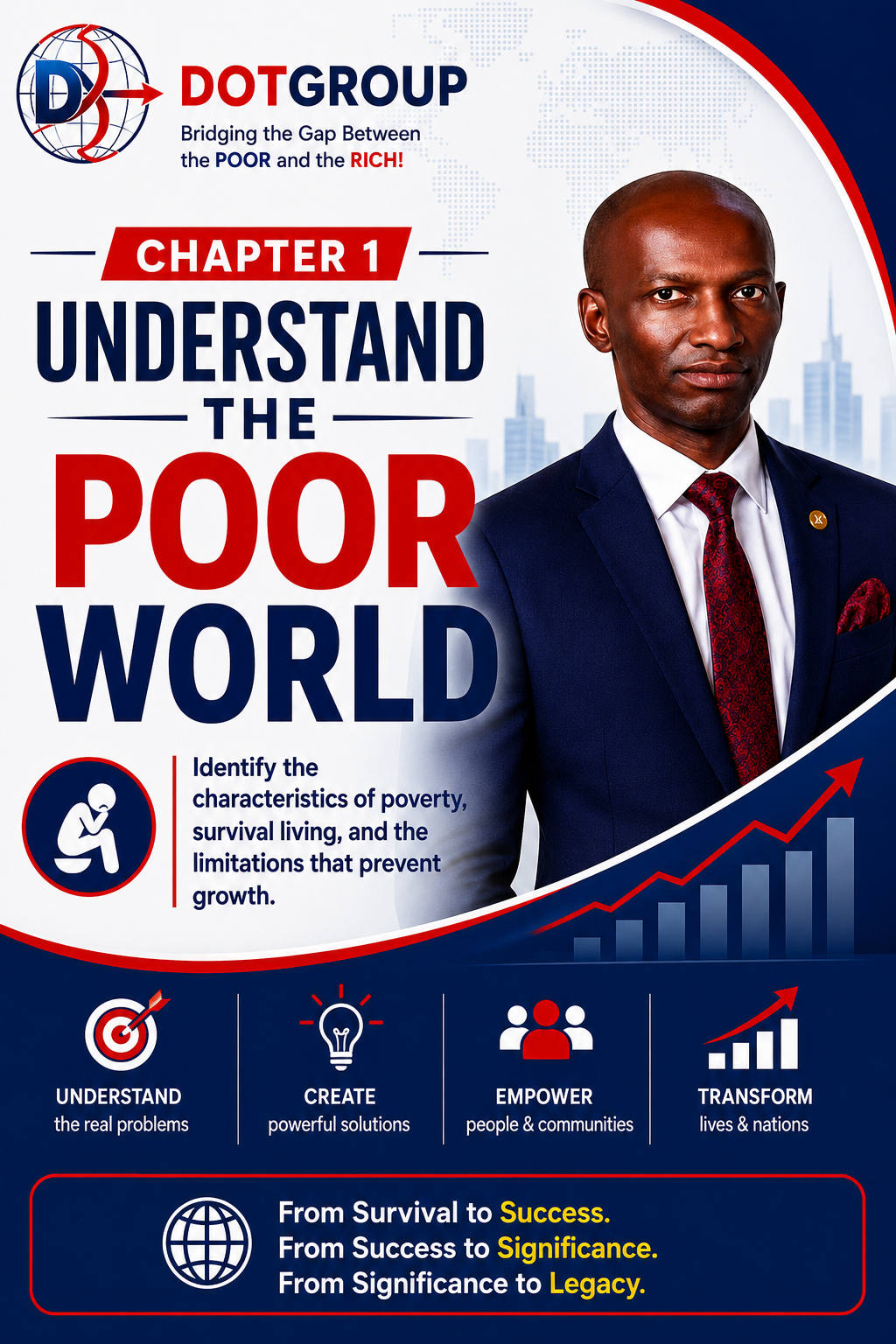
Poverty has a face: survival. And walls: the limitations that silence potential.
"The greatest poverty is not an empty pocket, but an empty vision. The moment you begin to see opportunities where others see obstacles, your journey out of the Poor World has already begun."
– David Onyibo Okaka
INTRODUCTION
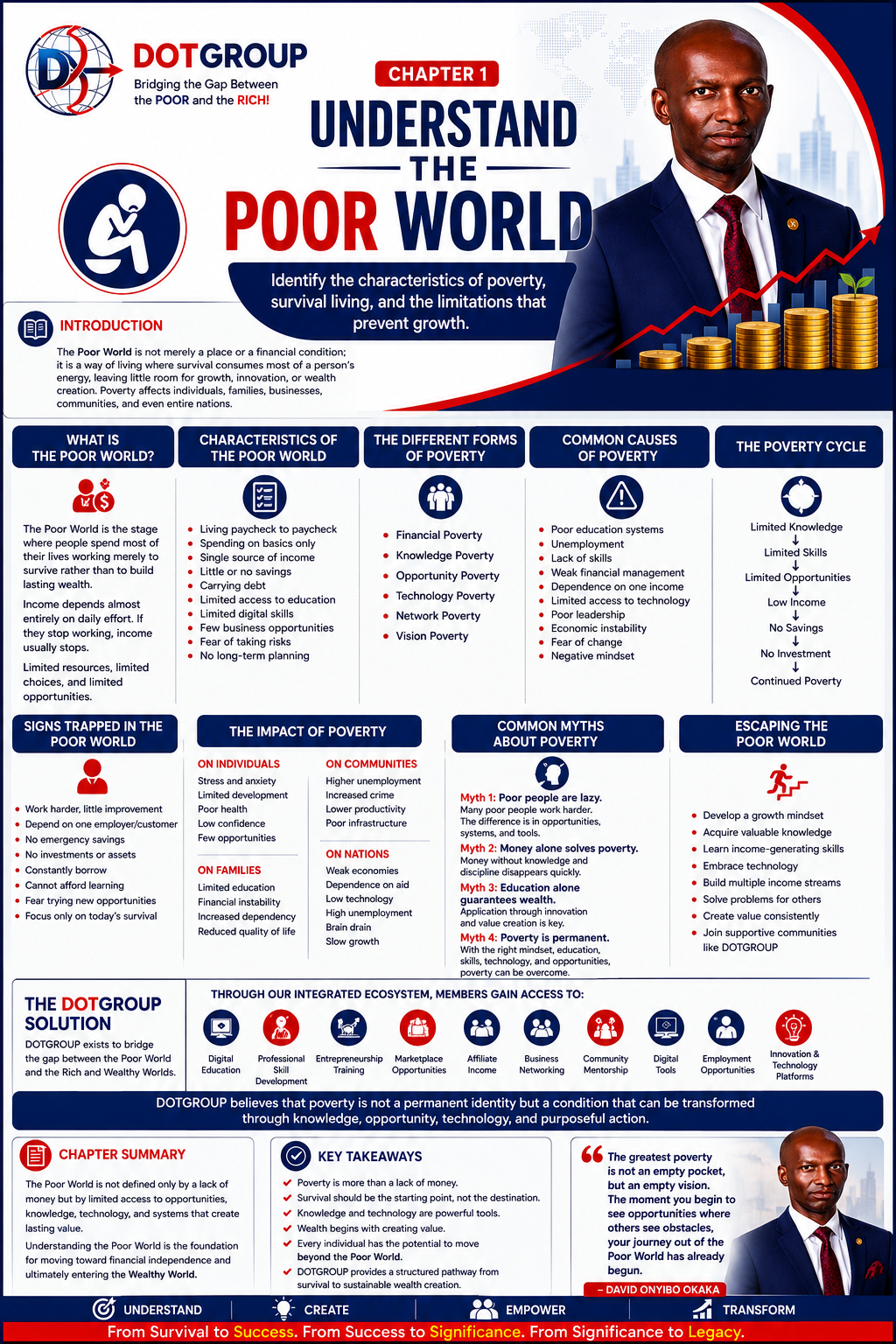
The Poor World is not merely a place or a financial condition; it is a way of living where survival consumes most of a person's energy, leaving little room for growth, innovation, or wealth creation. Poverty affects individuals, families, businesses, communities, and even entire nations.
Many people believe that being poor simply means not having money. However, poverty is much deeper. It can be a shortage of knowledge, opportunities, technology, networks, skills, vision, or productive systems.
Understanding the Poor World is the first step toward escaping it. One cannot solve a problem without first understanding its causes.
WHAT IS THE POOR WORLD?
The Poor World is the stage where people spend most of their lives working merely to survive rather than to build lasting wealth.
People in the Poor World often exchange time directly for money. Their income depends almost entirely on their daily effort. If they stop working, their income usually stops as well.
This cycle makes it difficult to accumulate assets, invest in opportunities, or prepare for the future.
The Poor World is characterized by limited resources, limited choices, and limited opportunities.
CHARACTERISTICS OF THE POOR WORLD
People living in the Poor World often experience one or more of the following:
Living from paycheck to paycheck.
Spending almost all income on basic necessities.
Depending on a single source of income.
Having little or no savings.
Carrying debt without productive investments.
Limited access to quality education.
Limited digital skills.
Few business opportunities.
Fear of taking calculated risks.
Lack of long-term financial planning.
These characteristics are not signs of failure. They are often symptoms of systems and circumstances that restrict growth.
THE DIFFERENT FORMS OF POVERTY
Poverty is multidimensional. It goes beyond money.
FFINANCIAL POVERTY
Insufficient income to meet essential needs or invest in future opportunities.
KNOWLEDGE POVERTY
Limited access to education, information, or practical skills that improve productivity.
OPPORTUNITY POVERTY
Few opportunities for employment, entrepreneurship, or career advancement.
TECHNOLOGY POVERTY
Limited access to digital tools, internet connectivity, and modern innovations.
NETWORK POVERTY
A lack of mentors, professional relationships, business partners, and supportive communities.
VISION POVERTY
An inability to see possibilities beyond current circumstances or to plan for long-term success.
COMMON CAUSES OF POVERTY
Many factors contribute to poverty, including:
Poor education systems.
Unemployment and underemployment.
Lack of entrepreneurial skills.
Weak financial management.
Dependence on one source of income.
Limited access to technology.
Poor leadership and governance.
Economic instability.
Fear of change.
Negative mindset and limiting beliefs.
Most people do not remain poor because they lack ability. They remain poor because they lack access to opportunities and systems that help them grow.
THE POVERTY CYCLE
The Poor World often follows a repeating cycle:
Limited Knowledge
↓
Limited Skills
↓
Limited Opportunities
↓
Low Income
↓
No Savings
↓
No Investment
↓
Continued Poverty
Unless this cycle is interrupted through education, skill development, technology, and opportunity creation, it tends to repeat across generations.
SIGNS THAT SOMEONE IS TRAPPED IN THE POOR WORLD
A person may be trapped in the Poor World if they:
Work harder every year but see little improvement.
Depend entirely on one employer or one customer.
Have no emergency savings.
Have no investment or appreciating assets.
Constantly borrow to meet daily needs.
Cannot afford continuous learning.
Fear trying new opportunities.
Focus only on today's survival instead of tomorrow's possibilities.
THE IMPACT OF POVERTY
Poverty affects every area of life.
On Individuals
Stress and anxiety.
Limited personal development.
Poor health outcomes.
Reduced confidence.
Few career opportunities.
On Families
Limited educational opportunities.
Financial instability.
Increased dependency.
Reduced quality of life.
On Communities
Higher unemployment.
Increased crime.
Lower productivity.
Poor infrastructure.
On Nations
Countries trapped in the Poor World often experience:
Weak economies.
Heavy dependence on foreign aid.
Low technological development.
High unemployment.
Brain drain.
Slow economic growth.
COMMON MYTHS ABOUT POVERTY
Myth 1
Poor people are lazy.
Many poor people work harder than wealthy people. The difference often lies in the opportunities, systems, and tools available to them.
Myth 2
Money alone solves poverty.
Money without knowledge and discipline often disappears quickly.
Myth 3
Education alone guarantees wealth.
Education is valuable, but applying knowledge through innovation, entrepreneurship, and value creation is equally important.
Myth 4
Poverty is permanent.
With the right mindset, education, skills, technology, and opportunities, poverty can be overcome.
ESCAPING THE POOR WORLD
Leaving the Poor World begins with intentional action.
The journey includes:
Developing a growth mindset.
Acquiring valuable knowledge.
Learning income-generating skills.
Embracing technology.
Building multiple sources of income.
Solving problems for others.
Creating value consistently.
Joining supportive communities like DOTGROUP.
THE DOTGROUP SOLUTION
DOTGROUP exists to bridge the gap between the Poor World and the Rich and Wealthy Worlds.
Through its integrated ecosystem, members gain access to:
Digital education.
Professional skill development.
Entrepreneurship training.
Marketplace opportunities.
Affiliate income.
Business networking.
Community mentorship.
Digital tools.
Employment opportunities.
Innovation and technology platforms.
DOTGROUP believes that poverty is not a permanent identity but a condition that can be transformed through knowledge, opportunity, technology, and purposeful action.
CHAPTER SUMMARY
The Poor World is not defined only by a lack of money but by limited access to opportunities, knowledge, technology, and systems that create lasting value.
Understanding the Poor World is the foundation for moving toward financial independence and ultimately entering the Wealthy World.
KEY TAKEAWAYS
Poverty is more than a lack of money.
Survival should be the starting point, not the destination.
Knowledge and technology are powerful tools for escaping poverty.
Wealth begins with creating value.
Every individual has the potential to move beyond the Poor World.
DOTGROUP provides a structured pathway from survival to sustainable wealth creation.
QUESTIONS
OBJECTIVE
1. Which statement best describes the Poor World?
A. A stage where people build lasting wealth through investments.
B. A stage where people mainly work to survive rather than build wealth.
C. A stage where everyone owns businesses.
D. A stage where technology solves every financial problem.
2. Poverty is best described as:
A. A lack of money only.
B. A lack of formal education only.
C. A multidimensional condition involving limited knowledge, opportunities, technology, networks, and vision.
D. A condition that affects only unemployed people.
3. Which of the following is NOT a characteristic of the Poor World?
A. Living from paycheck to paycheck.
B. Multiple sustainable income streams.
C. Limited digital skills.
D. Lack of long-term financial planning.
4. Which form of poverty refers to limited access to education and practical skills?
A. Financial Poverty
B. Technology Poverty
C. Knowledge Poverty
D. Network Poverty
5. Which of the following is a common cause of poverty?
A. Strong financial management.
B. Multiple income streams.
C. Poor leadership and governance.
D. Continuous learning.
6. According to the Poverty Cycle, what usually comes after "Limited Skills"?
A. High Income
B. Limited Opportunities
C. Wealth Creation
D. Financial Freedom
7. Which of the following is a sign that someone may be trapped in the Poor World?
A. Investing in appreciating assets.
B. Building several income streams.
C. Constantly borrowing to meet daily needs.
D. Developing valuable digital skills.
8. Which statement is TRUE about poverty?
A. Poor people are always lazy.
B. Education alone guarantees wealth.
C. Poverty is permanent.
D. Poverty can be overcome through knowledge, skills, technology, and opportunities.
9. Which of the following is one of the recommended ways to escape the Poor World?
A. Avoid taking calculated risks.
B. Depend on one source of income.
C. Create value consistently for others.
D. Stop learning after getting a job.
10. The primary mission of DOTGROUP is to:
A. Help people become government employees.
B. Bridge the gap between the Poor World and the Rich and Wealthy Worlds.
C. Focus only on social networking.
D. Teach only computer programming.
THEORY
1. Define the Poor World and explain why poverty is more than simply a lack of money.
2. Discuss the different forms of poverty highlighted in this chapter and explain how each one affects personal and financial growth.
3. Explain the Poverty Cycle and describe practical ways an individual can break free from it.
4. Describe the impact of poverty on individuals, families, communities, and nations.
5. Explain how DOTGROUP provides a pathway for individuals to move from the Poor World to sustainable wealth creation.
LEARN MORE WITH DOTGROUP
Break free from the cycle of poverty and build a brighter future through:
- Personal and financial development
- Digital and professional skills training
- Entrepreneurship education
- Employment and business opportunities
- Wealth creation strategies
- Community mentorship and support
Visit: Our Courses
"Poverty is not your identity—it is a condition that can be changed. The moment you invest in knowledge, develop valuable skills, embrace technology, and create value for others, you begin your journey from survival to significance."
David Onyibo Okaka